Egyptian Numerals
The ancient Egyptians wrote numbers with small pictures: a stroke for 1, a heel bone for 10, a coil of rope for 100 and a lotus flower for 1,000. Learn the symbols, read the chart from 1 to 100, and calculate like a scribe.
Also available in: Deutsch · Français · Italiano · Español · Português
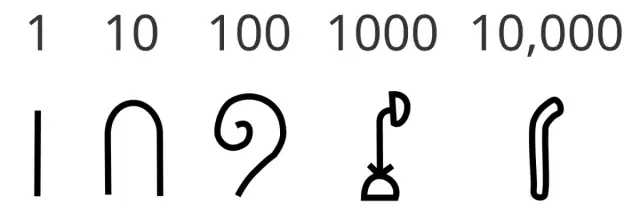
Egyptian numerals are hieroglyphs for the powers of ten: a stroke is 1, a heel bone (also called a cattle hobble) is 10, a coil of rope is 100 and a lotus flower is 1,000. Three more signs, a finger, a tadpole and a man with raised arms, stand for 10,000, 100,000 and 1,000,000. You draw each symbol as often as you need it and add up the values.
This page shows the hieroglyph numbers, a chart from 1 to 100, how to write large numbers, and how the Egyptians added, multiplied by doubling and wrote fractions. A German version with printable puzzles for children is at Ägyptische Zahlen (in German).
The seven hieroglyph symbols for numbers
Each symbol is worth ten times the one before it. For all numbers up to 999 the first three are enough.
| Value | Symbol | What it shows |
|---|---|---|
| 1 | Stroke | a vertical line |
| 10 | Heel bone (cattle hobble) | an arch like an upside-down U |
| 100 | Coil of rope | a rolled-up rope, drawn as a spiral |
| 1,000 | Lotus flower (water lily) | a flower on a stem |
| 10,000 | Finger | a bent, pointing finger |
| 100,000 | Tadpole (frog) | an animal with a head and a tail |
| 1,000,000 | Heh | a kneeling man with raised arms |
Books name some symbols differently. The heel bone is also called a cattle hobble, and the lotus a water lily. The same sign is meant each time. Here you see the first five symbols in the original style:

How to write Egyptian numbers
- Split the number into thousands, hundreds, tens and ones.
- Draw a lotus for each thousand, a coil of rope for each hundred, a heel bone for each ten and a stroke for each one.
- The order does not matter. For easy counting, the larger symbols usually come first and equal symbols are stacked in short rows.
To read a number, count each kind of symbol and add the values. Two coils of rope, one heel bone and three strokes make 200 + 10 + 3 = 213. The tens are simply 1 to 9 heel bones, the hundreds 1 to 9 coils: 90 is nine heel bones, 100 is one coil.
No zero and no place value
We write 213 with three digits, where the 2 means 200 because of its place. The Egyptians had no places. They had a separate symbol for each size, which is why the order does not matter. That is also why they needed no zero: for 205 they drew 2 coils and 5 strokes and simply left out the heel bone. For us the tens place needs a 0, otherwise 205 would look like 25. Compare this with the Hindu-Arabic numerals and with other types of number systems.
| Number | Coils of rope | Heel bones | Strokes | Egyptian symbols in all | Our digits |
|---|---|---|---|---|---|
| 7 | 0 | 0 | 7 | 7 | 1 |
| 12 | 0 | 1 | 2 | 3 | 2 |
| 24 | 0 | 2 | 4 | 6 | 2 |
| 99 | 0 | 9 | 9 | 18 | 2 |
| 100 | 1 | 0 | 0 | 1 | 3 |
| 136 | 1 | 3 | 6 | 10 | 3 |
| 205 | 2 | 0 | 5 | 7 | 3 |
| 305 | 3 | 0 | 5 | 8 | 3 |
| 999 | 9 | 9 | 9 | 27 | 3 |
The table shows the price of this system. Large numbers need many symbols: 999 has three digits in our system but 27 symbols in the Egyptian one. Roman numerals repeat signs too, but they use fewer of them.
Egyptian numerals 1 to 100: the chart
The charts show every number from 1 to 100 in Egyptian numerals. In each cell the heel bones for the tens are on top and the strokes for the ones below. Small numbers, like 4, are written in two short rows to make them easier to count. The 100 is a single coil of rope.
In the charts you can see a pattern: the numbers in one column share the same strokes, and the heel bones increase by one every ten steps. The numbers from 91 to 99 are the longest. The number up to 100 with the most symbols is 99, with 18 signs, while 100 needs only one.
Writing large numbers
For thousands and above, the lotus, finger, tadpole and Heh are added. The method stays the same: draw each symbol as often as needed.
| Number | Symbols | Symbols in all |
|---|---|---|
| 1,234 | 1 lotus, 2 coils of rope, 3 heel bones, 4 strokes | 10 |
| 12,345 | 1 finger, 2 lotus flowers, 3 coils of rope, 4 heel bones, 5 strokes | 15 |
| 123,456 | 1 tadpole, 2 fingers, 3 lotus flowers, 4 coils of rope, 5 heel bones, 6 strokes | 21 |
| 1,234,567 | 1 man with raised arms (Heh), 2 tadpoles, 3 fingers, 4 lotus flowers, 5 coils of rope, 6 heel bones, 7 strokes | 28 |
| 1,000,000 | 1 man with raised arms (Heh) | 1 |
The Egyptians knew numbers above a million. A mace head of king Narmer, from about 3100 BC, lists numbers of captured people and animals in the hundreds of thousands and above. The numbers on it are among the oldest in the world.
Adding with Egyptian numerals
- Write both numbers in symbols.
- Put equal symbols together.
- Swap ten equal symbols for one of the next size: ten strokes become a heel bone, ten heel bones a coil of rope, ten coils a lotus.
Egyptian multiplication: the doubling method
The Egyptians multiplied with doubling and adding only. This method is known from the Rhind papyrus, a calculation book copied by the scribe Ahmes around 1550 BC. To compute 13 × 12, double 12 again and again, and then pick the rows whose multipliers add up to 13.
| Multiplier | Doubled value | Used? |
|---|---|---|
| 1 | 12 | yes |
| 2 | 24 | |
| 4 | 48 | yes |
| 8 | 96 | yes |
The multipliers 1, 4 and 8 add up to 13, so 13 × 12 = 12 + 48 + 96 = 156. The method works for every whole number, because every number is a sum of different powers of two (the same fact behind the binary system). Another example: for 25 × 14 use 1 + 8 + 16 = 25, so you add 14 + 112 + 224 = 350.
A worksheet in German, Ägyptische Multiplikation, lets you practice this.
Egyptian fractions
The Egyptians wrote almost all fractions as unit fractions, fractions with numerator 1, written with a mouth sign above the number. Only a few fractions had signs of their own: 1/2, 2/3 and, less often, 3/4. Every other fraction was split into different unit fractions: 3/4 = 1/2 + 1/4, 2/5 = 1/3 + 1/15, 2/7 = 1/4 + 1/28 and 5/6 = 1/2 + 1/3. The Rhind papyrus begins with a table that gives 2 divided by each odd number up to 101 in this form.
Hieroglyphic and hieratic numerals
The hieroglyphs were used on monuments. For everyday writing on papyrus, scribes used hieratic, a fast cursive script that runs from right to left. Its numerals combined repeated signs: there is a separate sign for each digit from 1 to 9, each ten from 10 to 90 and each hundred. That makes the writing shorter but means more signs to learn. The Rhind papyrus is written in hieratic. Egypt never developed a place value system like the Babylonian one, whose steps are explained on Babylonian numerals, and the digits we use today came from India instead.
Practice problems with answers
Frequently asked questions
How do you write Egyptian numerals?
Split the number into thousands, hundreds, tens and ones, and draw a lotus, a coil of rope, a heel bone or a stroke for each one. The order does not matter. See how to write Egyptian numbers.
What are the Egyptian numerals from 1 to 10?
The numbers 1 to 9 are that many strokes, in short rows. The number 10 is a heel bone, an arch like an upside-down U. See the chart from 1 to 100.
How do you write 100 and 1,000 in Egyptian numerals?
100 is a coil of rope, a spiral, and 1,000 is a lotus flower on a stem.
What are the Egyptian number symbols?
Stroke (1), heel bone (10), coil of rope (100), lotus (1,000), finger (10,000), tadpole (100,000) and Heh, the man with raised arms (1,000,000). See the symbols table.
Did the Egyptians have a zero?
Not as a digit, because they did not need one. Their numerals had no places, and a missing symbol simply meant “none.” Only in some account books does a word sign stand for “nothing left.”
How did the Egyptians multiply?
By doubling and adding. To compute 13 × 12 they doubled 12 three times and added the rows for 1, 4 and 8 to get 156. See Egyptian multiplication.
What is the Egyptian numeration system called?
It is an additive, decimal system. It has no place value, and each power of ten has its own hieroglyph.
Sources and further reading
- MacTutor History of Mathematics: Egyptian numerals
- MacTutor History of Mathematics: Egyptian papyri
- British Museum: The Rhind Mathematical Papyrus (EA 10058)
- Annette Imhausen: Mathematics in Ancient Egypt. A Contextual History, Princeton University Press, Princeton 2016.
- Gay Robins, Charles Shute: The Rhind Mathematical Papyrus. An Ancient Egyptian Text, British Museum Publications, London 1987.
- Jim Ritter: Closing the Eye of Horus: The Rise and Fall of “Horus-Eye Fractions,” in: J. M. Steele, A. Imhausen (eds.): Under One Sky, Ugarit-Verlag, Münster 2002, pp. 297–323.
Spotted a mistake or have a request? Send us a short message and we will take care of it.