History of Pi
For almost 4,000 years people have tried to pin down the ratio of a circle’s circumference to its diameter. The story features clay tablets, polygons, series, a gravestone, a bill about 3.2 and computers that now calculate trillions of digits.
Divide the circumference of a circle by its diameter and you always get the same number, whether for a coin, a wagon wheel or the orbit of Earth. It starts 3.14159 and never ends. This number, pi (π), has occupied people for millennia like hardly any other: craftsmen needed it for barrels and domes, astronomers for orbits, mathematicians for the question whether it can ever be captured completely. This is the history of pi, from the first approximations to the record of 314 trillion digits.
You also find the first 100 digits of pi, an experiment you can do at home and the story of Pi Day on March 14. A German version of this article is Die Zahl Pi (in German). For the wider story of mathematics see the history of mathematics.
Babylon, Egypt and the Bible: the first approximations
The first values came from practice. A clay tablet excavated in Susa in 1936 gives the circumference of a circle as 3 1/8 times the diameter, that is 3.125. In Egypt the scribe Ahmes treated the area of a circle in the Rhind papyrus (about 1550 BC) as the square of 8/9 of the diameter. That corresponds to π ≈ (16/9)² = 256/81 ≈ 3.1605, about 0.6 percent too large.
The Bible is often quoted in the story of π, too. The First Book of Kings (7:23) describes the “molten sea” in Solomon’s temple, a round basin ten cubits across and thirty cubits around. Many read “π = 3” into this. But the text makes no mathematical statement about a ratio. It describes a vessel in round numbers, and reading a mistake into it expects too much of the text.
| Who | Value | Decimal | Difference from π |
|---|---|---|---|
| Babylon, tablet from Susa | 3 1/8 = 25/8 | 3.125000 | −0.5282 % |
| Egypt, Rhind papyrus (about 1550 BC) | (16/9)² = 256/81 | 3.160494 | +0.6016 % |
| Archimedes, lower bound | 3 10/71 = 223/71 | 3.140845 | −0.0238 % |
| Archimedes, upper bound | 3 1/7 = 22/7 | 3.142857 | +0.0402 % |
| Aryabhata (476–550) | 3.1416 | 3.141600 | +0.000234 % |
| Zu Chongzhi (5th century) | 355/113 | 3.141593 | +0.000008 % |
Archimedes and the polygons
A real method came from Archimedes of Syracuse around 250 BC. He drew regular polygons inside and outside a circle. The circumference lies between the perimeters of the two polygons, and the more corners they have, the narrower the gap. With 96 corners he got 3 10/71 < π < 3 1/7, in decimals 3.1408 < π < 3.1429. What was new was not the value but the proof that it must lie between two limits. The upper value 22/7 is still in school books today and differs from π by only 0.04 percent. More about him is on the Archimedes profile.
In China, Liu Hui pushed the same method forward in the 3rd century with polygons of several thousand sides. In the 5th century Zu Chongzhi found the fraction 355/113 = 3.1415929…, which differs from π only in the seventh decimal place. For over 900 years nobody came closer. It is easy to remember: write 113355 and divide the back half (355) by the front half (113).
Infinite series from India
A new idea came from southern India in the 14th century. Madhava of Sangamagrama (about 1340 to 1425) found infinite series that write π as a sum of ever smaller fractions: π/4 = 1 − 1/3 + 1/5 − 1/7 + … Now one is no longer tied to polygons. Madhava computed π to eleven decimal places. In Europe the same series was discovered independently in the 17th century by James Gregory and later by Gottfried Wilhelm Leibniz, which is why it is also called the Leibniz series. It converges slowly: after 1,000 terms, 4 times the sum gives only 3.1406, so only three digits are right. Madhava improved it with correction terms.
Ludolph van Ceulen and the “Ludolphine number”
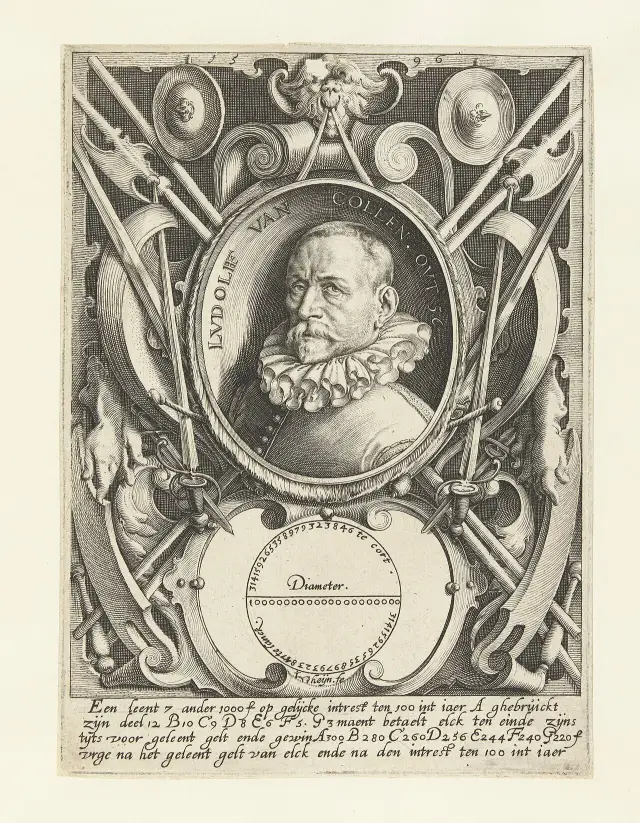
Polygons found their most dedicated champion around 1600. The master of arithmetic and fencing teacher Ludolph van Ceulen (1540–1610), who lived in Delft and Leiden, calculated for decades with polygons of ever more corners. In 1596 he published 20 digits, and by his death he had reached 35. His effort became proverbial: in Germany π was long called the Ludolphine number. According to tradition, the digits were carved on his gravestone in St. Peter’s Church in Leiden. The original was lost, and a replica was set up in the church in 2000.

The symbol π and the fast formulas
The Welsh teacher William Jones was the first to use the letter π in this sense, in 1706, for the ratio of circumference to diameter. In the same year the astronomer John Machin published a formula that made it much faster to compute π, and he won 100 digits with it. Leonhard Euler adopted the sign, used it in his writings and textbooks and made it the standard. Since then we write π. A later high point of formula and hand calculation was the Englishman William Shanks, who gave π to 707 places in 1873. Only in the 20th century, according to the usual account in 1944, was it discovered that he had made a mistake at the 528th place, and everything after was wrong.
Is π a fraction? Lambert and Lindemann
Alongside the calculation grew another question: can π be written as a fraction at all? Johann Heinrich Lambert showed in the 1760s that it cannot, so π is irrational. The year 1761 is often named, and the proof was printed in 1768. The decimals therefore never end and never repeat.
Stronger still is what Ferdinand von Lindemann proved in 1882: π is transcendental. It is not the solution of any polynomial equation with whole-number coefficients. It follows that you can never construct with compass and straightedge a square with exactly the same area as a given circle. This ancient problem, the squaring of the circle, had occupied mathematicians for over 2,000 years and was finally solved, as unsolvable. The phrase “squaring the circle” for something impossible comes from it.
Ramanujan, Chudnovsky and the computers
In the 20th century everything changed. In 1914 the self-taught Indian mathematician Srinivasa Ramanujan published series for π that converge astonishingly fast: each term gives about eight new digits. Building on this, David and Gregory Chudnovsky developed a series in 1989 that gives about 14 digits per term. This method is still inside the record programs today. See Ramanujan in the list of famous mathematicians.
In 1949 the vacuum tube computer ENIAC ran for 70 hours and delivered 2,037 digits. That was a test of the machine and not a need: John von Neumann had proposed to study the digits of famous constants statistically. Since then the number of digits has grown in leaps:
- 1949: 2,037 digits (ENIAC).
- 2022: 100 trillion digits (Google Cloud).
- 2024: 202 trillion digits (StorageReview).
- April 2025: 300 trillion digits (Linus Media Group and Kioxia).
- 2025: 314 trillion digits (StorageReview with Micron), confirmed as a record by Guinness World Records in June 2026.
Status: November 2026. According to Guinness the run took nearly 110 days on a single server. The record will probably not stand for long. It says less about mathematics than about computing technology: it serves as a stress test for processors and storage.
The first 100 digits of pi
The first 100 decimal places of π, written in groups of ten:
3.1415926535 8979323846 2643383279 5028841971 6939937510 5820974944 5923078164 0628620899 8628034825 3421170679
Rounded, that is 3.14 for everyday use, 3.1416 for most school tasks and 3.141592653589793 with 15 decimal places for navigating space probes. The first zero stands only at the 32nd decimal place. Whether every sequence of digits appears equally often, that is whether π is a so-called normal number, has still not been proved. To compute circles with π, use the circle calculator (interface in German).
Pi Day on March 14
Hardly any other number has a day of its own. The physicist Larry Shaw at the Exploratorium in San Francisco linked the date March 14 (3/14 in American style) with the first digits 3.14 in 1988, and the museum celebrated with fruit pie. In 2009 the U.S. House of Representatives supported Pi Day. In 2019 UNESCO declared March 14 the International Day of Mathematics, which was first celebrated in 2020.
Timeline
- about 1900–1600 BC Babylon: π ≈ 3 1/8.
- about 1550 BC Rhind papyrus: π ≈ 256/81 ≈ 3.1605.
- about 250 BC Archimedes encloses π with the 96-gon.
- 5th century Zu Chongzhi gives 355/113.
- 14th century Madhava finds infinite series for π.
- 1610 Ludolph van Ceulen dies with 35 digits.
- 1706 William Jones introduces π, and John Machin finds his formula.
- 1768 Lambert publishes the proof of irrationality.
- 1882 Lindemann proves the transcendence of π.
- 1949 ENIAC delivers 2,037 digits.
Practice problems with answers
Frequently asked questions
What is the history of pi in short?
Babylonians and Egyptians used approximations around 1900 to 1600 BC. Archimedes enclosed π with polygons around 250 BC, Indian mathematicians found infinite series in the 14th century, and Lambert and Lindemann proved in the 18th and 19th centuries that π is irrational and transcendental. Today computers have calculated 314 trillion digits.
Who discovered pi?
Nobody alone. That the ratio of circumference to diameter is constant was known to early cultures. The first method that proves bounds is from Archimedes. The symbol π was first used in this sense by William Jones in 1706.
What are the first 100 digits of pi?
3.1415926535 8979323846 2643383279 5028841971 6939937510 5820974944 5923078164 0628620899 8628034825 3421170679. See the list.
Why do we use the symbol π?
The Greek letter π is generally thought to stand for the Greek words for “periphery” and “perimeter.” William Jones used it for the ratio in 1706, and Euler made it standard.
What is the origin of Pi Day?
Larry Shaw started it at the Exploratorium in San Francisco in 1988. March 14 is 3/14 in American date style. See Pi Day.
How many digits of pi are known?
The current record is 314 trillion digits, confirmed by Guinness World Records in June 2026. For practical purposes 15 digits are enough for space navigation.
Is pi exactly 22/7 or 3.14?
No. 22/7 and 3.14 are approximations. Pi is irrational, so it is no exact fraction, and its decimals never end or repeat.
Sources and further reading
- MacTutor History of Mathematics: A history of Pi
- Guinness World Records: Pi-high computing achievement, 1 June 2026 (the headline wrongly says 340 instead of 314 trillion)
- NASA JPL: How Many Decimals of Pi Do We Really Need?
- Exploratorium: A Slice of Pi Day History
- Wikipedia: Indiana pi bill
- Petr Beckmann: A History of π, St. Martin’s Press, New York 1971.
Spotted a mistake or have a request? Send us a short message and we will take care of it.